Queue of changes for a specific parameter: Vst::IParamValueQueue. More...
#include "ivstparameterchanges.h"
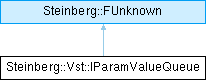
Public Member Functions | |
| virtual ParamID PLUGIN_API | getParameterId ()=0 |
| Returns its associated ID. | |
| virtual int32 PLUGIN_API | getPointCount ()=0 |
| Returns count of points in the queue. | |
| virtual tresult PLUGIN_API | getPoint (int32 index, int32 &sampleOffset, ParamValue &value)=0 |
| Gets the value and offset at a given index. | |
| virtual tresult PLUGIN_API | addPoint (int32 sampleOffset, ParamValue value, int32 &index)=0 |
| Adds a new value at the end of the queue, its index is returned. | |
 Public Member Functions inherited from Steinberg::FUnknown Public Member Functions inherited from Steinberg::FUnknown | |
| virtual tresult PLUGIN_API | queryInterface (const TUID _iid, void **obj)=0 |
| Query for a pointer to the specified interface. | |
| virtual uint32 PLUGIN_API | addRef ()=0 |
| Adds a reference and returns the new reference count. | |
| virtual uint32 PLUGIN_API | release ()=0 |
| Releases a reference and returns the new reference count. | |
Static Public Attributes | |
| static const FUID | iid |
| Static Public Attributes inherited from Steinberg::FUnknown | |
| static const FUID | iid |
Detailed Description
Queue of changes for a specific parameter: Vst::IParamValueQueue.
- [host imp]
- [released: 3.0.0]
- [mandatory]
The change queue can be interpreted as segment of an automation curve. For each processing block, a segment with the size of the block is transmitted to the processor. The curve is expressed as sampling points of a linear approximation of the original automation curve. If the original already is a linear curve, it can be transmitted precisely. A non-linear curve has to be converted to a linear approximation by the host. Every point of the value queue defines a linear section of the curve as a straight line from the previous point of a block to the new one. So the plug-in can calculate the value of the curve for any sample position in the block.
Implicit Points:
In each processing block, the section of the curve for each parameter is transmitted. In order to reduce the amount of points, the point at block position 0 can be omitted.
- If the curve has a slope of 0 over a period of multiple blocks, only one point is transmitted for the block where the constant curve section starts. The queue for the following blocks will be empty as long as the curve slope is 0.
- If the curve has a constant slope other than 0 over the period of several blocks, only the value for the last sample of the block is transmitted. In this case, the last valid point is at block position -1. The processor can calculate the value for each sample in the block by using a linear interpolation:
Jumps:
A jump in the automation curve has to be transmitted as two points: one with the old value and one with the new value at the next sample position.

See IParameterChanges, ProcessData
Definition at line 84 of file ivstparameterchanges.h.
Member Data Documentation
◆ iid
|
static |
Definition at line 101 of file ivstparameterchanges.h.
The documentation for this class was generated from the following file:
- juce_audio_processors/format_types/VST3_SDK/pluginterfaces/vst/ivstparameterchanges.h