This class acts as a typed wrapper around a property inside a ValueTree. More...
#include "juce_CachedValue.h"
Public Member Functions | |
| CachedValue () | |
| Default constructor. | |
| CachedValue (ValueTree &tree, const Identifier &propertyID, UndoManager *undoManager) | |
| Constructor. | |
| CachedValue (ValueTree &tree, const Identifier &propertyID, UndoManager *undoManager, const Type &defaultToUse) | |
| Constructor. | |
| operator Type () const noexcept | |
| Returns the current value of the property. | |
| Type | get () const noexcept |
| Returns the current value of the property. | |
| const Type & | operator* () const noexcept |
| Dereference operator. | |
| const Type * | operator-> () const noexcept |
| Dereference operator. | |
| template<typename OtherType > | |
| bool | operator== (const OtherType &other) const |
| Returns true if the current value of the property (or the fallback value) is equal to other. | |
| template<typename OtherType > | |
| bool | operator!= (const OtherType &other) const |
| Returns true if the current value of the property (or the fallback value) is not equal to other. | |
| Value | getPropertyAsValue () |
| Returns the current property as a Value object. | |
| bool | isUsingDefault () const |
| Returns true if the current property does not exist and the CachedValue is using the fallback default value instead. | |
| Type | getDefault () const |
| Returns the current fallback default value. | |
| CachedValue & | operator= (const Type &newValue) |
| Sets the property. | |
| void | setValue (const Type &newValue, UndoManager *undoManagerToUse) |
| Sets the property. | |
| void | resetToDefault () |
| Removes the property from the referenced ValueTree and makes the CachedValue return the fallback default value instead. | |
| void | resetToDefault (UndoManager *undoManagerToUse) |
| Removes the property from the referenced ValueTree and makes the CachedValue return the fallback default value instead. | |
| void | setDefault (const Type &value) |
| Resets the fallback default value. | |
| void | referTo (ValueTree &tree, const Identifier &property, UndoManager *um) |
| Makes the CachedValue refer to the specified property inside the given ValueTree. | |
| void | referTo (ValueTree &tree, const Identifier &property, UndoManager *um, const Type &defaultVal) |
| Makes the CachedValue refer to the specified property inside the given ValueTree, and specifies a fallback value to use if the property does not exist. | |
| void | forceUpdateOfCachedValue () |
| Force an update in case the referenced property has been changed from elsewhere. | |
| ValueTree & | getValueTree () noexcept |
| Returns a reference to the ValueTree containing the referenced property. | |
| const Identifier & | getPropertyID () const noexcept |
| Returns the property ID of the referenced property. | |
| UndoManager * | getUndoManager () noexcept |
| Returns the UndoManager that is being used. | |
Detailed Description
class juce::CachedValue< Type >
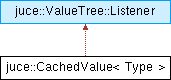
This class acts as a typed wrapper around a property inside a ValueTree.
A CachedValue provides an easy way to read and write a ValueTree property with a chosen type. So for example a CachedValue<int> allows you to read or write the property as an int, and a CachedValue<String> lets you work with it as a String.
It also allows efficient access to the value, by caching a copy of it in the type that is being used.
You can give the CachedValue an optional UndoManager which it will use when writing to the underlying ValueTree.
If the property inside the ValueTree is missing, the CachedValue will automatically return an optional default value, which can be specified when initialising the CachedValue.
To create one, you can either use the constructor to attach the CachedValue to a ValueTree, or can create an uninitialised CachedValue with its default constructor and then attach it later with the referTo() methods.
Common types like String, int, double which can be easily converted to a var should work out-of-the-box, but if you want to use more complex custom types, you may need to implement some template specialisations of VariantConverter which this class uses to convert between the type and the ValueTree's internal var.
@tags{DataStructures}
Definition at line 58 of file juce_CachedValue.h.
Constructor & Destructor Documentation
◆ CachedValue() [1/3]
|
default |
Default constructor.
Creates a default CachedValue not referring to any property. To initialise the object, call one of the referTo() methods.
◆ CachedValue() [2/3]
| juce::CachedValue< Type >::CachedValue | ( | ValueTree & | tree, |
| const Identifier & | propertyID, | ||
| UndoManager * | undoManager | ||
| ) |
Constructor.
Creates a CachedValue referring to a Value property inside a ValueTree. If you use this constructor, the fallback value will be a default-constructed instance of Type.
- Parameters
-
tree The ValueTree containing the property propertyID The identifier of the property undoManager The UndoManager to use when writing to the property
Definition at line 214 of file juce_CachedValue.h.
◆ CachedValue() [3/3]
| juce::CachedValue< Type >::CachedValue | ( | ValueTree & | tree, |
| const Identifier & | propertyID, | ||
| UndoManager * | undoManager, | ||
| const Type & | defaultToUse | ||
| ) |
Constructor.
Creates a default Cached Value referring to a Value property inside a ValueTree, and specifies a fallback value to use if the property does not exist.
- Parameters
-
tree The ValueTree containing the property propertyID The identifier of the property undoManager The UndoManager to use when writing to the property defaultToUse The fallback default value to use.
Definition at line 222 of file juce_CachedValue.h.
Member Function Documentation
◆ forceUpdateOfCachedValue()
| void juce::CachedValue< Type >::forceUpdateOfCachedValue | ( | ) |
Force an update in case the referenced property has been changed from elsewhere.
Note: The CachedValue is a ValueTree::Listener and therefore will be informed of changes of the referenced property anyway (and update itself). But this may happen asynchronously. forceUpdateOfCachedValue() forces an update immediately.
Definition at line 284 of file juce_CachedValue.h.
◆ get()
|
noexcept |
Returns the current value of the property.
If the property does not exist, returns the fallback default value.
Definition at line 105 of file juce_CachedValue.h.
◆ getDefault()
| Type juce::CachedValue< Type >::getDefault | ( | ) | const |
Returns the current fallback default value.
Definition at line 140 of file juce_CachedValue.h.
◆ getPropertyAsValue()
| Value juce::CachedValue< Type >::getPropertyAsValue | ( | ) |
Returns the current property as a Value object.
Definition at line 230 of file juce_CachedValue.h.
◆ getPropertyID()
|
noexcept |
Returns the property ID of the referenced property.
Definition at line 184 of file juce_CachedValue.h.
◆ getUndoManager()
|
noexcept |
Returns the UndoManager that is being used.
Definition at line 187 of file juce_CachedValue.h.
◆ getValueTree()
|
noexcept |
Returns a reference to the ValueTree containing the referenced property.
Definition at line 181 of file juce_CachedValue.h.
◆ isUsingDefault()
| bool juce::CachedValue< Type >::isUsingDefault | ( | ) | const |
Returns true if the current property does not exist and the CachedValue is using the fallback default value instead.
Definition at line 236 of file juce_CachedValue.h.
◆ operator Type()
|
noexcept |
Returns the current value of the property.
If the property does not exist, returns the fallback default value.
This is the same as calling get().
Definition at line 100 of file juce_CachedValue.h.
◆ operator!=()
| bool juce::CachedValue< Type >::operator!= | ( | const OtherType & | other | ) | const |
Returns true if the current value of the property (or the fallback value) is not equal to other.
Definition at line 128 of file juce_CachedValue.h.
◆ operator*()
|
noexcept |
Dereference operator.
Provides direct access to the property.
Definition at line 108 of file juce_CachedValue.h.
◆ operator->()
|
noexcept |
Dereference operator.
Provides direct access to members of the property if it is of object type.
Definition at line 113 of file juce_CachedValue.h.
◆ operator=()
| CachedValue< Type > & juce::CachedValue< Type >::operator= | ( | const Type & | newValue | ) |
Sets the property.
This will actually modify the property in the referenced ValueTree.
Definition at line 242 of file juce_CachedValue.h.
◆ operator==()
| bool juce::CachedValue< Type >::operator== | ( | const OtherType & | other | ) | const |
Returns true if the current value of the property (or the fallback value) is equal to other.
Definition at line 119 of file juce_CachedValue.h.
◆ referTo() [1/2]
| void juce::CachedValue< Type >::referTo | ( | ValueTree & | tree, |
| const Identifier & | property, | ||
| UndoManager * | um | ||
| ) |
Makes the CachedValue refer to the specified property inside the given ValueTree.
Definition at line 272 of file juce_CachedValue.h.
◆ referTo() [2/2]
| void juce::CachedValue< Type >::referTo | ( | ValueTree & | tree, |
| const Identifier & | property, | ||
| UndoManager * | um, | ||
| const Type & | defaultVal | ||
| ) |
Makes the CachedValue refer to the specified property inside the given ValueTree, and specifies a fallback value to use if the property does not exist.
Definition at line 278 of file juce_CachedValue.h.
◆ resetToDefault() [1/2]
| void juce::CachedValue< Type >::resetToDefault | ( | ) |
Removes the property from the referenced ValueTree and makes the CachedValue return the fallback default value instead.
Definition at line 259 of file juce_CachedValue.h.
◆ resetToDefault() [2/2]
| void juce::CachedValue< Type >::resetToDefault | ( | UndoManager * | undoManagerToUse | ) |
Removes the property from the referenced ValueTree and makes the CachedValue return the fallback default value instead.
Definition at line 265 of file juce_CachedValue.h.
◆ setDefault()
| void juce::CachedValue< Type >::setDefault | ( | const Type & | value | ) |
Resets the fallback default value.
Definition at line 160 of file juce_CachedValue.h.
◆ setValue()
| void juce::CachedValue< Type >::setValue | ( | const Type & | newValue, |
| UndoManager * | undoManagerToUse | ||
| ) |
Sets the property.
This will actually modify the property in the referenced ValueTree.
Definition at line 249 of file juce_CachedValue.h.
The documentation for this class was generated from the following file:
- juce_data_structures/values/juce_CachedValue.h