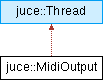
Represents a midi output device. More...
#include "juce_MidiDevices.h"
Classes | |
| class | Pimpl |
Public Member Functions | |
| ~MidiOutput () override | |
| Destructor. | |
| MidiDeviceInfo | getDeviceInfo () const noexcept |
| Returns the MidiDeviceInfo struct containing some information about this device. | |
| String | getIdentifier () const noexcept |
| Returns the identifier of this device. | |
| String | getName () const noexcept |
| Returns the name of this device. | |
| void | setName (const String &newName) noexcept |
| Sets a custom name for the device. | |
| void | sendMessageNow (const MidiMessage &message) |
| Sends out a MIDI message immediately. | |
| void | sendBlockOfMessagesNow (const MidiBuffer &buffer) |
| Sends out a sequence of MIDI messages immediately. | |
| void | sendBlockOfMessages (const MidiBuffer &buffer, double millisecondCounterToStartAt, double samplesPerSecondForBuffer) |
| This lets you supply a block of messages that will be sent out at some point in the future. | |
| void | clearAllPendingMessages () |
| Gets rid of any midi messages that had been added by sendBlockOfMessages(). | |
| void | startBackgroundThread () |
| Starts up a background thread so that the device can send blocks of data. | |
| void | stopBackgroundThread () |
| Stops the background thread, and clears any pending midi events. | |
| bool | isBackgroundThreadRunning () const noexcept |
| Returns true if the background thread used to send blocks of data is running. | |
Static Public Member Functions | |
| static Array< MidiDeviceInfo > | getAvailableDevices () |
| Returns a list of the available midi output devices. | |
| static MidiDeviceInfo | getDefaultDevice () |
| Returns the MidiDeviceInfo of the default midi output device to use. | |
| static std::unique_ptr< MidiOutput > | openDevice (const String &deviceIdentifier) |
| Tries to open one of the midi output devices. | |
| static std::unique_ptr< MidiOutput > | createNewDevice (const String &deviceName) |
| This will try to create a new midi output device (only available on Linux, macOS and iOS). | |
Detailed Description
Represents a midi output device.
To create one of these, use the static getAvailableDevices() method to find out what outputs are available, and then use the openDevice() method to try to open one.
- See also
- MidiInput
@tags{Audio}
Definition at line 324 of file juce_MidiDevices.h.
Class Documentation
◆ juce::MidiOutput::Pimpl
| class juce::MidiOutput::Pimpl |
Definition at line 762 of file juce_Midi_linux.cpp.
Constructor & Destructor Documentation
◆ ~MidiOutput()
|
override |
Destructor.
Definition at line 764 of file juce_Midi_linux.cpp.
Member Function Documentation
◆ clearAllPendingMessages()
| void juce::MidiOutput::clearAllPendingMessages | ( | ) |
Gets rid of any midi messages that had been added by sendBlockOfMessages().
Definition at line 159 of file juce_MidiDevices.cpp.
◆ createNewDevice()
|
static |
This will try to create a new midi output device (only available on Linux, macOS and iOS).
This will attempt to create a new midi output device with the specified name that other apps can connect to and use as their midi input.
NB - if you are calling this method on iOS you must have enabled the "Audio Background Capability" setting in the iOS exporter otherwise this method will fail.
Returns an empty object if a device can't be created.
- Parameters
-
deviceName the name of the device to create
Definition at line 769 of file juce_Midi_linux.cpp.
◆ getAvailableDevices()
|
static |
Returns a list of the available midi output devices.
You can open one of the devices by passing its identifier into the openDevice() method.
- See also
- MidiDeviceInfo, getDevices, getDefaultDeviceIndex, openDevice
Definition at line 766 of file juce_Midi_linux.cpp.
◆ getDefaultDevice()
|
static |
Returns the MidiDeviceInfo of the default midi output device to use.
Definition at line 767 of file juce_Midi_linux.cpp.
◆ getDeviceInfo()
|
noexcept |
Returns the MidiDeviceInfo struct containing some information about this device.
Definition at line 373 of file juce_MidiDevices.h.
◆ getIdentifier()
|
noexcept |
Returns the identifier of this device.
Definition at line 376 of file juce_MidiDevices.h.
◆ getName()
|
noexcept |
Returns the name of this device.
Definition at line 379 of file juce_MidiDevices.h.
◆ isBackgroundThreadRunning()
|
noexcept |
Returns true if the background thread used to send blocks of data is running.
Definition at line 428 of file juce_MidiDevices.h.
◆ openDevice()
|
static |
Tries to open one of the midi output devices.
This will return a MidiOutput object if it manages to open it, you can then send messages to this device.
If the device can't be opened, this will return an empty object.
- Parameters
-
deviceIdentifier the ID of the device to open - use the getAvailableDevices() method to find the available devices that can be opened
- See also
- getDevices
Definition at line 768 of file juce_Midi_linux.cpp.
◆ sendBlockOfMessages()
| void juce::MidiOutput::sendBlockOfMessages | ( | const MidiBuffer & | buffer, |
| double | millisecondCounterToStartAt, | ||
| double | samplesPerSecondForBuffer | ||
| ) |
This lets you supply a block of messages that will be sent out at some point in the future.
The MidiOutput class has an internal thread that can send out timestamped messages - this appends a set of messages to its internal buffer, ready for sending.
This will only work if you've already started the thread with startBackgroundThread().
A time is specified, at which the block of messages should be sent. This time uses the same time base as Time::getMillisecondCounter(), and must be in the future.
The samplesPerSecondForBuffer parameter indicates the number of samples per second used by the MidiBuffer. Each event in a MidiBuffer has a sample position, and the samplesPerSecondForBuffer value is needed to convert this sample position to a real time.
Definition at line 120 of file juce_MidiDevices.cpp.
◆ sendBlockOfMessagesNow()
| void juce::MidiOutput::sendBlockOfMessagesNow | ( | const MidiBuffer & | buffer | ) |
Sends out a sequence of MIDI messages immediately.
Definition at line 114 of file juce_MidiDevices.cpp.
◆ sendMessageNow()
| void juce::MidiOutput::sendMessageNow | ( | const MidiMessage & | message | ) |
Sends out a MIDI message immediately.
Definition at line 765 of file juce_Midi_linux.cpp.
◆ setName()
Sets a custom name for the device.
Definition at line 382 of file juce_MidiDevices.h.
◆ startBackgroundThread()
| void juce::MidiOutput::startBackgroundThread | ( | ) |
Starts up a background thread so that the device can send blocks of data.
Call this to get the device ready, before using sendBlockOfMessages().
Definition at line 171 of file juce_MidiDevices.cpp.
◆ stopBackgroundThread()
| void juce::MidiOutput::stopBackgroundThread | ( | ) |
Stops the background thread, and clears any pending midi events.
- See also
- startBackgroundThread
Definition at line 176 of file juce_MidiDevices.cpp.
The documentation for this class was generated from the following files:
- juce_audio_devices/midi_io/juce_MidiDevices.h
- juce_audio_devices/midi_io/juce_MidiDevices.cpp
- juce_audio_devices/native/juce_Midi_linux.cpp