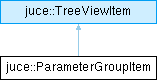
Public Member Functions | |
| ParameterGroupItem (AudioProcessorEditor &editor, const AudioProcessorParameterGroup &group) | |
| bool | mightContainSubItems () override |
| Tells the tree whether this item can potentially be opened. | |
| std::unique_ptr< Component > | createItemComponent () override |
| Creates a component that will be used to represent this item. | |
 Public Member Functions inherited from juce::TreeViewItem Public Member Functions inherited from juce::TreeViewItem | |
| TreeViewItem () | |
| Constructor. | |
| virtual | ~TreeViewItem () |
| Destructor. | |
| int | getNumSubItems () const noexcept |
| Returns the number of sub-items that have been added to this item. | |
| TreeViewItem * | getSubItem (int index) const noexcept |
| Returns one of the item's sub-items. | |
| void | clearSubItems () |
| Removes any sub-items. | |
| void | addSubItem (TreeViewItem *newItem, int insertPosition=-1) |
| Adds a sub-item. | |
| template<class ElementComparator > | |
| void | addSubItemSorted (ElementComparator &comparator, TreeViewItem *newItem) |
| Adds a sub-item with a sort-comparator, assuming that the existing items are already sorted. | |
| void | removeSubItem (int index, bool deleteItem=true) |
| Removes one of the sub-items. | |
| template<class ElementComparator > | |
| void | sortSubItems (ElementComparator &comparator) |
| Sorts the list of sub-items using a standard array comparator. | |
| TreeView * | getOwnerView () const noexcept |
| Returns the TreeView to which this item belongs. | |
| TreeViewItem * | getParentItem () const noexcept |
| Returns the item within which this item is contained. | |
| bool | isOpen () const noexcept |
| True if this item is currently open in the TreeView. | |
| void | setOpen (bool shouldBeOpen) |
| Opens or closes the item. | |
| Openness | getOpenness () const noexcept |
| Returns the openness state of this item. | |
| void | setOpenness (Openness newOpenness) |
| Opens or closes the item. | |
| bool | isSelected () const noexcept |
| True if this item is currently selected. | |
| void | setSelected (bool shouldBeSelected, bool deselectOtherItemsFirst, NotificationType shouldNotify=sendNotification) |
| Selects or deselects the item. | |
| Rectangle< int > | getItemPosition (bool relativeToTreeViewTopLeft) const noexcept |
| Returns the rectangle that this item occupies. | |
| void | treeHasChanged () const noexcept |
| Sends a signal to the TreeView to make it refresh itself. | |
| void | repaintItem () const |
| Sends a repaint message to redraw just this item. | |
| int | getRowNumberInTree () const noexcept |
| Returns the row number of this item in the tree. | |
| bool | areAllParentsOpen () const noexcept |
| Returns true if all the item's parent nodes are open. | |
| void | setLinesDrawnForSubItems (bool shouldDrawLines) noexcept |
| Changes whether lines are drawn to connect any sub-items to this item. | |
| virtual String | getUniqueName () const |
| Returns a string to uniquely identify this item. | |
| virtual void | itemOpennessChanged (bool isNowOpen) |
| Called when an item is opened or closed. | |
| virtual int | getItemWidth () const |
| Must return the width required by this item. | |
| virtual int | getItemHeight () const |
| Must return the height required by this item. | |
| virtual bool | canBeSelected () const |
| You can override this method to return false if you don't want to allow the user to select this item. | |
| virtual void | paintItem (Graphics &g, int width, int height) |
| Draws the item's contents. | |
| virtual void | paintOpenCloseButton (Graphics &, const Rectangle< float > &area, Colour backgroundColour, bool isMouseOver) |
| Draws the item's open/close button. | |
| virtual void | paintHorizontalConnectingLine (Graphics &, const Line< float > &line) |
| Draws the line that connects this item to the vertical line extending below its parent. | |
| virtual void | paintVerticalConnectingLine (Graphics &, const Line< float > &line) |
| Draws the line that extends vertically up towards one of its parents, or down to one of its children. | |
| virtual bool | customComponentUsesTreeViewMouseHandler () const |
| This should return true if you want to use a custom component, and also use the TreeView's built-in mouse handling support, enabling drag-and-drop, itemClicked() and itemDoubleClicked(); return false if the component should consume all mouse clicks. | |
| virtual void | itemClicked (const MouseEvent &) |
| Called when the user clicks on this item. | |
| virtual void | itemDoubleClicked (const MouseEvent &) |
| Called when the user double-clicks on this item. | |
| virtual void | itemSelectionChanged (bool isNowSelected) |
| Called when the item is selected or deselected. | |
| virtual void | ownerViewChanged (TreeView *newOwner) |
| Called when the owner view changes. | |
| virtual String | getTooltip () |
| The item can return a tool tip string here if it wants to. | |
| virtual String | getAccessibilityName () |
| Use this to set the name for this item that will be read out by accessibility clients. | |
| virtual var | getDragSourceDescription () |
| To allow items from your TreeView to be dragged-and-dropped, implement this method. | |
| virtual bool | isInterestedInFileDrag (const StringArray &files) |
| If you want your item to be able to have files drag-and-dropped onto it, implement this method and return true. | |
| virtual void | filesDropped (const StringArray &files, int insertIndex) |
| When files are dropped into this item, this callback is invoked. | |
| virtual bool | isInterestedInDragSource (const DragAndDropTarget::SourceDetails &dragSourceDetails) |
| If you want your item to act as a DragAndDropTarget, implement this method and return true. | |
| virtual void | itemDropped (const DragAndDropTarget::SourceDetails &dragSourceDetails, int insertIndex) |
| When a things are dropped into this item, this callback is invoked. | |
| void | setDrawsInLeftMargin (bool canDrawInLeftMargin) noexcept |
| Sets a flag to indicate that the item wants to be allowed to draw all the way across to the left edge of the TreeView. | |
| void | setDrawsInRightMargin (bool canDrawInRightMargin) noexcept |
| Sets a flag to indicate that the item wants to be allowed to draw all the way across to the right edge of the TreeView. | |
| std::unique_ptr< XmlElement > | getOpennessState () const |
| Saves the current state of open/closed nodes so it can be restored later. | |
| void | restoreOpennessState (const XmlElement &xml) |
| Restores the openness of this item and all its sub-items from a saved state. | |
| int | getIndexInParent () const noexcept |
| Returns the index of this item in its parent's sub-items. | |
| bool | isLastOfSiblings () const noexcept |
| Returns true if this item is the last of its parent's sub-items. | |
| String | getItemIdentifierString () const |
| Creates a string that can be used to uniquely retrieve this item in the tree. | |
Public Attributes | |
| String | name |
Additional Inherited Members | |
| Public Types inherited from juce::TreeViewItem | |
| enum class | Openness { opennessDefault , opennessClosed , opennessOpen } |
| An enum of states to describe the explicit or implicit openness of an item. More... | |
Detailed Description
Definition at line 536 of file juce_GenericAudioProcessorEditor.cpp.
Constructor & Destructor Documentation
◆ ParameterGroupItem()
| juce::ParameterGroupItem::ParameterGroupItem | ( | AudioProcessorEditor & | editor, |
| const AudioProcessorParameterGroup & | group | ||
| ) |
Definition at line 538 of file juce_GenericAudioProcessorEditor.cpp.
Member Function Documentation
◆ createItemComponent()
|
overridevirtual |
Creates a component that will be used to represent this item.
You don't have to implement this method - if it returns nullptr then no component will be used for the item, and you can just draw it using the paintItem() callback. But if you do return a component, it will be positioned in the TreeView so that it can be used to represent this item.
The component returned will be managed by the TreeView and will be deleted later when it goes off the screen or is no longer needed. Its position and size will be completely managed by the tree, so don't attempt to move it around.
Something you may want to do with your component is to give it a pointer to the TreeView that created it. This is perfectly safe, and there's no danger of it becoming a dangling pointer because the TreeView will always delete the component before it is itself deleted.
As long as you stick to these rules you can return whatever kind of component you like. It's most useful if you're doing things like drag-and-drop of items, or want to use a Label component to edit item names, etc.
Reimplemented from juce::TreeViewItem.
Definition at line 559 of file juce_GenericAudioProcessorEditor.cpp.
◆ mightContainSubItems()
|
overridevirtual |
Tells the tree whether this item can potentially be opened.
If your item could contain sub-items, this should return true; if it returns false then the tree will not try to open the item. This determines whether or not the item will be drawn with a 'plus' button next to it.
Implements juce::TreeViewItem.
Definition at line 557 of file juce_GenericAudioProcessorEditor.cpp.
Member Data Documentation
◆ name
| String juce::ParameterGroupItem::name |
Definition at line 564 of file juce_GenericAudioProcessorEditor.cpp.
The documentation for this struct was generated from the following file:
- juce_audio_processors/processors/juce_GenericAudioProcessorEditor.cpp